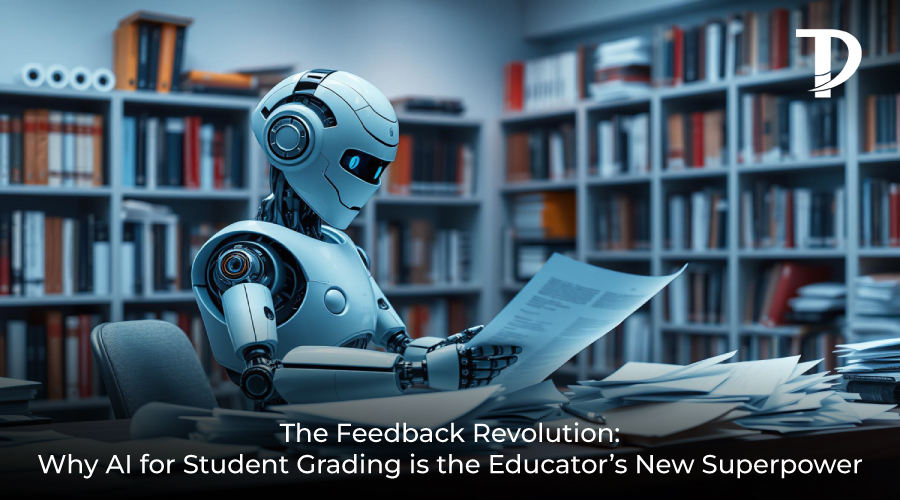
In this time, the image of a teacher hunched over a mountain of papers at midnight is becoming a relic of the past. As educational institutions worldwide navigate a digital-first era, Student Grading with AI has shifted from a futuristic concept to a foundational tool. This evolution isn’t just about speed; it’s about a fundamental shift in how we measure human intellect and growth.
While the “red pen” was once a sign of authority, educators today use algorithms to provide each student with deeper insights, faster feedback, and a more individualized learning experience.
The New Era of Student Grading with AI
Traditionally, grading was a bottleneck. A teacher with 150 students might take two weeks to return an essay, by which time the student has moved on. AI for Student Grading effectively shatters this lag.
Natural Language Processing (NLP) and Multiple Analysis are utilized by current AI systems to understand context, logic, and even the emotional tone of a student’s work.
1. From Objective to Subjective: The Shift in Capabilities
Historically, “automated grading” meant Scantron machines—bubbles and number two pencils. By 2026, the capabilities have expanded:
- Using objective grading: Multiple-choice, true/false, and math problems are instantly evaluated.
- STEM Precision: AI can now precisely pinpoint where a student’s reasoning diverged from the correct path by tracing the logic of a Python script or a multi-step calculus problem.
- Subjective Analysis: Though still a “human-in-the-loop” process, AI can now analyze essay structure, argumentative coherence, and thematic depth in subjects related to the humanities.
How AI is Reshaping the Classroom
The integration of AI for students and educators is generating a “feedback loop” that was previously not imagined.
Instant Feedback and Growth
The most crucial benefit is the immediacy. When a student submits a test paper, an AI assistant can provide instant feedback on grammar and flow. This allows the student to refine their work before it reaches the teacher’s desk. This “formative assessment” transforms grading from a post-mortem of failure into a roadmap for improvement.
Consistency and the “Fatigue Factor”
Humans are subjective. A teacher may grade the first paper of the night differently than the fiftieth. AI provides a baseline of unwavering consistency, applying the same rubric to every student without the influence of exhaustion or subconscious bias.
Predictive Analytics
AI tools now analyze performance trends over months. If a student’s grades in “logical reasoning” are dipping across multiple subjects, the AI alerts the educator to a potential learning gap before it results in a failing grade.
Top AI Assessment Tools in 2026
| Tool | Primary Strength | Best For |
|---|---|---|
| Gradescope | AI-assisted grouping of similar answers. | Higher Education & STEM |
| Examino | High-fidelity handwriting recognition from scans. | Physical Paper Assessments |
| Disco | Community-driven feedback and social learning. | Non-traditional & Online Courses |
| Turnitin AI | Integrity checking plus logic-based grading. | Writing and Research Papers |
| Wolfram Alpha | Deep mathematical and computational logic. | Physics, Math, and Engineering |
The Ethical Balancing Act: Bias and the Human Touch
As we embrace AI for Student Grading, we must address the “black box” problem. AI models are trained on historical data, which can contain human biases. Students from a variety of linguistic backgrounds may be unfairly penalized by a model if it focuses primarily on one dialect or writing style.
Addressing the “Subjectivity Gap”
Can AI appreciate the beauty of a metaphor? Can it sense the “soul” of a creative writing piece? Most experts in 2026 agree: Not yet. AI is excellent at evaluating structure, but humans are essential for evaluating creativity. The most successful models today are Hybrid Models, where AI handles the technical “heavy lifting” (grammar, formatting, basic logic) and the educator provides the nuanced, empathetic final review.
Key Note: Transparency is the currency of 2026. Students have a right to know when AI is being used and how the rubric is applied. Ethical grading requires an “appeal” process where a human teacher can overrule an algorithmic decision.
The Student’s Perspective: Empowered, Not Replaced
- Personalized Learning Paths: In an AI-graded quiz, if a student has trouble understanding a particular idea, the system will automatically suggest related videos or exercises.
- Reduced Anxiety: The “wait time” for grades is a major source of student stress. Instant results allow for immediate closure and faster pivots in study habits.
- Skill Mastery: By focusing on “competency-based” grading, AI allows students to progress as they master a skill, rather than waiting for the rest of the class to catch up.
Conclusion: The Educator as a Mentor
The rise of AI in grading doesn’t make teachers obsolete; it makes them more human. By offloading the mechanical, repetitive tasks of assessment to algorithms, teachers can return to what they do best: mentoring, inspiring, and connecting.
At The Pioneer Tech we are expert in AI Implementation for any professional and Educational purpose with accurate result and time saving for teachers and Students.