When we talk about Artificial Intelligence, our minds usually jump straight to the “magic” at our fingertips. We think about chatbots that write poetry, image generators that create art, or the latest productivity tool in our browser.
But according to NVIDIA CEO Jensen Huang, focusing only on the apps we see is like admiring the frosting on a cake while ignoring whether the kitchen has electricity or even an oven.
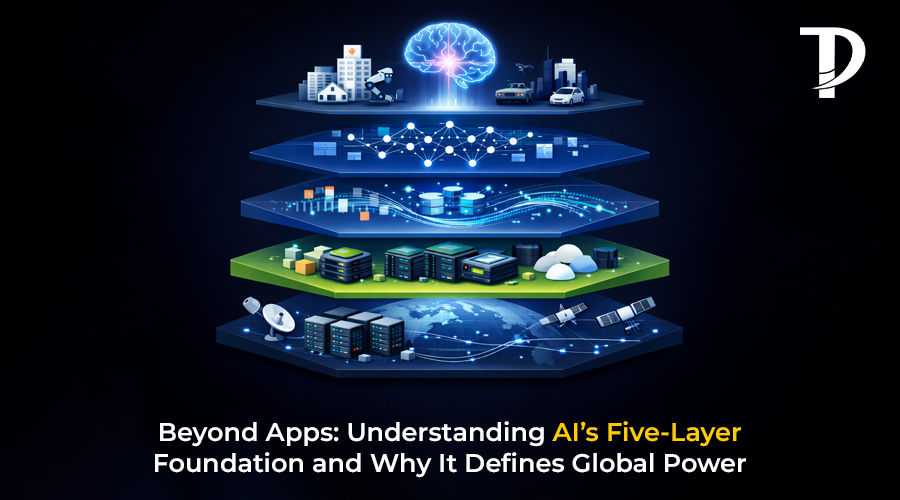
In a recent breakdown that has shifted the perspective of tech analysts and policymakers alike, Huang introduced the “5-Layer Cake” of AI. It’s a framework that explains why AI isn’t just a software race—it’s a massive, multi-dimensional geopolitical and industrial chess game.
Here is a deep dive into the five layers that will determine who wins the next decade of innovation.
1. Energy: The Foundation of the Foundation
At the very bottom of the stack—the base of the cake—is Energy. You cannot have AI without massive amounts of electricity. AI data centers are power-hungry giants, and the ability to generate, transmit, and manage that energy is now a national security priority.
Huang points out a critical shift here: while the U.S. leads in software, countries like China currently hold significant advantages in energy infrastructure and the speed of scaling power grids. Without a sustainable, massive energy supply, the layers above simply cannot exist.
2. Chips: The Engines of Intelligence
The second layer is the hardware: GPUs (Graphics Processing Units) and specialized semiconductors. This is the processing power that allows models to “think.”
Currently, the U.S. holds a significant lead in chip design and architecture (largely thanks to NVIDIA itself). However, Huang highlights a brewing challenge: design is only half the battle. Manufacturing and the supply chain for these chips remain a global bottleneck. To stay ahead, a nation doesn’t just need the best blueprints; it needs the physical capacity to produce them at scale.
3. Infrastructure: The Modern Factory
If chips are the engines, Infrastructure is the factory. This layer consists of the physical data centers and the high-speed networks that connect thousands of GPUs together.
The challenge here is speed of construction. Building a state-of-the-art AI data center is a feat of civil engineering. Huang notes a stark contrast in how quickly these facilities are built across the globe, pointing out that the U.S. faces significant hurdles in construction speed compared to the rapid industrial mobilization seen in China. In the AI race, time is a resource as valuable as capital.
4. Models: The Digital Brains
This is the layer most people are familiar with—Large Language Models (LLMs) like GPT-4 or Claude. These are the “foundational” models trained on vast amounts of data.
Currently, U.S. “frontier” models are widely considered the most advanced in the world. However, the landscape is shifting. China is proving to be incredibly resilient and strong in the open-source arena, creating high-quality models that are accessible and adaptable. The battle here is between proprietary “closed” excellence and collaborative “open” speed.
5. Applications: The User Experience
Finally, we reach the top layer: Applications. This is the software, the “wrappers,” and the consumer-facing tools that we use every day.
While the media and the stock market often obsess over this layer, Huang’s warning is clear: Applications are the result, not the cause, of AI dominance. If you have the best app but don’t control the energy, the chips, or the infrastructure, your position is inherently fragile.
The Big Picture: Why the “Stack” Matters
The key takeaway from Jensen Huang’s analysis is a wake-up call for businesses and governments: Sustainable AI dominance is a vertical struggle.
You cannot win the AI race by just writing good code. National competitiveness now depends on an “all-of-the-above” strategy. If a country leads in Models (Layer 4) but fails to secure Energy (Layer 1) or Infrastructure (Layer 3), the entire stack collapses under its own weight or becomes dependent on a competitor.
Conclusion,
We are moving out of the era of “Silicon Valley” being just about software. We are entering an era of “Industrial AI,” where the winner will be the one who can master the physical world—power, steel, and silicon—just as well as they master the digital one.
“In the rapidly evolving landscape of the ‘5-layer cake,’ having the right tools is only half the battle—knowing how to use them is what defines a leader. At The Pioneer Tech, we bridge the gap between AI potential and real-world performance. Through our specialized AI Implementation services, we build the infrastructure your business needs to scale, while our comprehensive AI Training programs empower your workforce to master the tools of tomorrow. Don’t just watch the AI revolution happen; lead it with The Pioneer Tech.”